Text of Cardinal McElroy’s Labor Day Mass Homily
Labor Day Mass 2026
St. Matthew’s Cathedral
Washington, D.C.
Cardinal McElroy Homily
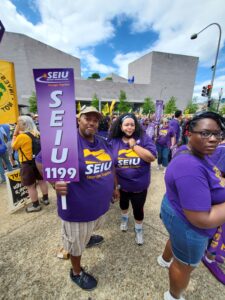
It’s wonderful to be with you here today, and to welcome all our regular parishioners, at the Cathedral, and all those who are visiting here. And especially on this day, to welcome on this Labor Day weekend, representatives of workers and workers themselves, and organized labor in the Catholic Labor Network.
In the first reading today, from the book of Genesis, we see the foundation of the Church’s entire understanding of the meaning of work, and of its products. It is God who brings the whole of the earth into being, creating our universe out of nothing. Every blessing that we know on this earth is a gift to us from God, created in grace, and given to us in love. And the whole of the created order is bestowed upon us, not as individuals but as the community of peoples, of all of humanity who live in this world.
Church teaching says to us a very important truth, and it says it again, and again, and again. The creation is the gift of God to all. Catholic theologists calls it the universal destination of all goods. No one intrinsically owns anything. All that is that has come ultimately from the gift of God, belongs to all of us. Private property exists, and it exists as accommodation to the ways of the world, to make economies work. But in a more fundamental sense, the gift of the created order and all that has flown from it, is the heritage of all. Catholic teaching says that it is the heritage of all. We have to remember that, everyone has a right to part of the world’s bounty. But also on this world, we are called to be co-creators with God, to take that bounty and, through our lives and our labor, build it up.
In Catholic theology, for every gift and right, there is a responsibility. And for the gift and the rights of all the material goods of creation, we have a responsibility, all of us, to help build that up. And for most of us, it is through work, through our labor, and all the different kinds of work we undertake in this world.
Part of this work is bestowed upon us as a responsibility for us because we need to participate in building up the world, in making the order of creation more beautiful, more worthwhile, more beneficial to all of humanity. But part of it is because when we are workers, we are co-creators with God. It is God who brought everything into being, but when we work, in the dignity of our labor, we are co-creators with God.
You know, for us in the Church, the great example of the co-creator is St. Joseph. You know, the father of Jesus, he was a carpenter. In his carpentry, he made a home for his family, and he was a responsible participant in the community, in the life of building up the earth. That is the call for each of us in our lives.
Work is not something imposed upon us merely as a burden. We all know it can be burdensome from time to time. But work is given to us as a way of self-expression, of our need, of our human need to create, to contribute to, to build up here on this earth and in all the communities that we enrich in our lives.
So that is the fundamental teaching of the Church. As God created all the earth and all that we know in this life, so we are called to build upon that, by our labor, by our talents, by our responsibility, by our commitment, by working, even when some days it’s really hard to get up and go to work. That we are co-creators with God and that there is a dignity to human work that is immense and should never be damaged or undermined.
A great moment in modern Catholic social teaching was when the Church confronted tremendous damage upon workers in the world at the time of the Industrial Revolution. Pope Leo XIII wrote an encyclical called Rerum Novarum because he was bringing the church and society to grips with the fact that when the world shifted from agrarian life to industrial life, there were immense new threats to workers. Terribly inhumane working conditions, exploitation of wages, tearing apart of families, lack of security. And thus, the end of the 19th century Rerum Novarum says to us: in the world there needs to be an understanding of the dignity of work that all respect; that workers respect, that governments respect, that employers respect, and to try to make humane the living conditions and benefits and pay for those who labor every day to help themselves, their families, our society, and to build up the world. And in that particular moment, the rights of organized labor were particularly important as being a counterforce to the raw economic power of major employers. And that has been in Catholic teaching strongly since that period.
Today, we are on the cusp of another revolution that will dramatically affect work in our world and the dignity of labor.
In August, Cardinal Tobin, Cardinal Cupich, and I, who are the three American cardinals who are heads of dioceses, spent several days in Silicon Valley with the heads of the AI teams in what they call the frontier labs, those who are on the cutting edge.
And they spoke very openly about the state of AI – where they’re going, where the strengths are, where the challenges are. And there are many of them – many strengths, many blessings will come from this, but also there are many destructive elements to it and one of the areas we spoke about was that of work and of labor and what AI is going to do and, particularly down the road a few more years, the development of robotics in tandem with AI is going to accelerate tremendously changes in the workforce. And the question is, will there be meaningful work left? And will that meaningful work be allocated in a way which offers opportunities to all of us in this world to be co-creators? To have places of work where we can contribute to the world and build it up?
And the answer to that is, no one knows. The labor market is going to radically change in the next 20 years and there are certain sectors where they feel will essentially be wiped out by AI, and there are other sectors, some of them surprising, some of them about manual labor and social service and all those things which will not be, but what we do know is there going to be a tremendous dislocation of workers. Millions of workers who have jobs now will not have those jobs 10 years from now.
And thus, we as a society have to be at the table seeking this vision of work and seeking to make sure that exploitation does not grow and that the wealth of the country doesn’t increasingly go to the fewer and the fewer at the expense of the working class.
We have to be there in terms of understanding where our government should go, where we as a society should go, where the economy should go. And that is the challenge for labor in our day of anticipating this and making sure that as decisions unfold that are going to have such tremendous repercussions for all workers, that there are tremendous efforts, thought-out efforts, structures in place to make this transition one which allows for continued creation through labor and the buildup of the human family by understanding the dignity we have as workers, and what we are called to be and what we are called to do in this world.
So on this Labor Day, let us give thanks to the Lord for the beauty of creation, for the dignity of labor, which God has bestowed upon us. Let us give thanks for all those who work in this world. Let us give thanks for men and women and children of families who have little of this world’s good. And let us do everything that we can to vindicate workers in this moment in which we live and in the years which are going to come, which will transform human labor. That we might have a labor force and a labor opportunity that truly reflects the gift of God to us all, the call of God to us all, and the wonderful talents we have, to build up the creation that God gave us in the book of Genesis in the first reading today.
Transcript taken from live stream video. Please excuse any typos.